The seasons
1960 A Lotus at Monaco, a crash at Spa, a win at Riverside
Stirling Moss gave Lotus its first World Championship win at Monaco in 1960, was badly hurt in practice at Spa, raced again in August and won at Riverside.

1960
The record
- World Championship starts
- 5
- World Championship wins
- 2
- Pole positions
- 4
- Podiums
- 3
- Fastest laps
- 2
- Team
- R.R.C. Walker Racing Team
- Car
- Cooper T51–Climax (Argentina); Lotus 18–Climax (from Monaco)
- Tyres
- Dunlop
- Numbers
- 36 and 38 (Trintignant’s), 28, 7, 12, 12, 5
- Team-mates
- Maurice Trintignant (Argentina)
- Points
- 19
- Finished
- 3rd · champion Jack Brabham, 43 points
1960 · The season
With 35 laps of the Monaco Grand Prix still to run, on 29 May 1960, Rob Walker’s pit hung out a board telling Stirling Moss that he had 5 laps to go. A digit had slipped. Moss had rejoined only a few laps before, after a stop to have a plug lead refitted, and the board woke him up with a start.
It was his first race in a Lotus 18, and he won it: the first World Championship win for Lotus, scored by Walker’s private car rather than by Colin Chapman’s works team. Three weeks later, in practice at Spa, a stub axle of his Lotus broke and he was badly hurt. He was racing again in August, won the last Grand Prix of the year at Riverside, and was 3rd in the championship for the second year running, with 19 points to Jack Brabham’s 43.
The southern summer and the Birdcage
The season began in the southern summer. At East London, in the South African Grand Prix on 1 January, he was 2nd in a Cooper-Borgward and set the fastest lap; eight days later, in New Zealand, he set the fastest lap again and retired with a broken clutch.
On 7 February, in Argentina, at the Buenos Aires Autodrome, he started from pole in Walker’s Cooper T51. A poor start dropped him to 8th; he fought back through a duel with Jo Bonnier and Graham Hill to lead, and then his suspension broke. He took over the Walker Cooper of his team-mate, Maurice Trintignant, and chased Cliff Allison’s Ferrari to within 10 seconds at the finish, for 3rd place. Since 1958 a shared drive had scored nothing, and the 3rd place brought him no points.
In sports cars he drove the Maserati Tipo 61, the Birdcage, for Lloyd “Lucky” Casner’s American Camoradi team. He won the Cuban Grand Prix at Havana with it on 28 February, against opposition Motor Sport did not think very powerful. At Sebring on 26 March he and Dan Gurney were leading the 12 Hours easily when the transmission failed, and at the Nürburgring on 22 May, in mist, rain and fog, the two of them won the 1000 km, Moss’s fourth win in the race. The sports cars tells that race.

A Lotus for Monaco
At Goodwood on Easter Monday, 18 April, Moss drove Walker’s Cooper in the Glover Trophy and lost it to Innes Ireland’s Lotus 18 after a duel in which both of them lapped Goodwood at over 100 mph (161 km/h); Moss set the fastest lap, and the two were given a new award for the feat, the Goodwood Ton. The same day he won the Fordwater Trophy, a GT race, in an Aston Martin DB4 GT.
In Formula Two Walker now ran a single-seater Porsche 718/2, and the factory, Motor Sport noted, still kept an eye on the car. Moss first drove it at Syracuse in March, where he was fastest in practice and set a lap record before the engine failed. At the Brussels Grand Prix in April, run in two heats at the Heysel, he won the first; in the second he left the line in third gear, was last away, and came back to 3rd, which made him 2nd on aggregate to Brabham. On 30 April he won the Aintree 200, for Formula Two cars, in the Porsche, from pole after a poor start.
At Silverstone, in wet practice for the International Trophy, he lost the Cooper accelerating out of Woodcote and spun it into a parked works Aston Martin, badly damaging both. He took pole all the same, and in the race, in a spare chassis, he led until a front wishbone broke. Harry Schell had been killed in practice at the same meeting.
The Lotus had beaten the Coopers at Goodwood and again at Silverstone, and the Cooper works team’s contract with Esso stood in the way of Walker and Moss, who were with BP. Walker bought a Lotus 18 for Monaco. It was the new rear-engined car from Chapman, and, as Walker raced it, identical to the works cars but for thicker radius rods to the rear wheels, and dark blue instead of green. The radius rods were for a Colotti five-speed gearbox, which turned out too tall to fit in time, so the car kept the Lotus gearbox.
Monaco, 29 May
It was his first drive in a single-seater Lotus, and the car was brand new. At Monaco the official clock ran wrong in practice, by 3 seconds at first and by nearly 6 later; once it was put right Moss was easily fastest, in 1:36.3, a second clear of Brabham. To find out whether the fault lay in car or driver, Lance Reventlow let him try one of his struggling front-engined Scarabs, and Moss lapped in 1:45. The fault, Denis Jenkinson concluded in Motor Sport, was in both.
Bonnier’s BRM led from the second row. Moss was 2nd by lap 5, and after 10 laps Bonnier waved him by. Moss stayed where he was, and Jenkinson read the meaning of his gesture: “No, you took the lead, you can set the pace.” On lap 17, with a pack closing on them both, Moss went in front. From lap 28 rain made the circuit like an ice rink; Moss slowed right down to a pace he thought safe, and Brabham took the lead on lap 34, until on lap 41 he hit the wall at Ste Dévote. On lap 60 the Lotus began to run on three cylinders, and Moss stopped; a plug lead was refitted, and he rejoined behind Bonnier with 40 laps left.
A treacherous car, really. If you had the ability, a Lotus would beat a Cooper, but you had not nearly as much enjoyment driving it.
He retook the lead and drove the last laps with the greatest delicacy, and won by 52.1 seconds from Bruce McLaren, with Phil Hill 3rd. Jenkinson’s verdict was a single sentence: “An immaculate Moss finished an immaculate drive into first place.”
It was Walker’s first win with a Lotus; his earlier championship wins, in Argentina in 1958 and in Portugal and Italy in 1959, had come with Coopers. For Lotus it was the first win in the World Championship, though not the first in Formula One: Ireland’s Glover Trophy win at Goodwood had come in April, against Moss.
Zandvoort, 6 June
At Zandvoort Brabham went faster in practice, and Moss went faster again, for pole in 1:33.2. In the race he settled in behind the Cooper. He explained the tactic in 1994: “My biggest competitor was Jack Brabham, so I was just going to sit behind him and then take him later on.” He had been criticised so often for breaking cars while leading, he said, that he was not going to take the lead.
On lap 17 one of the granite blocks marking the edge of the track broke, and the Cooper’s rear wheel flung a piece of it, about the size of a book, at the Lotus. It smashed the front rim and burst the tyre. The Lotus had bolt-on wheels, so the stop was slow, and Moss rejoined in 12th place. He drove back to 4th and set the fastest lap on the last lap. Remembering the race in 1994, he put himself 3rd, and he gave up waiting behind: “so sod what the press say”.
1960
In the last practice session for the Belgian Grand Prix at Spa-Francorchamps, on the Saturday afternoon, the left rear stub axle of his Lotus broke as he took a bump at the exit of Burnenville, a curve taken at over 130 mph (209 km/h). The wheel came off. The car spun, hit the bank on the outside of the bend, threw him out and bounced across the road. Practice was stopped.
The report of the time gave a broken nose and back injuries, and later cracked bones in both legs, not serious; later accounts say that both legs were broken and three vertebrae crushed. At about the same time Michael Taylor was badly hurt when the steering column of his private Lotus broke.
Asked in 2006 whether he had ever been frightened, he said that he could not remember an accident caused by his own error, and that if Spa had been his fault he would have stopped racing at once. “But it was a Chapman failure, so it was acceptable.”
In the race the next day Chris Bristow, in a Yeoman Credit Cooper, crashed at Burnenville on lap 19 and was killed. On lap 25 Alan Stacey, in a works Lotus, crashed at Malmedy and was killed.
Moss missed the French and British Grands Prix, and was at Silverstone in July as a spectator.
1960 · The return
Karlskoga, 7 August
Seven weeks and a day after Spa he raced again, at Karlskoga in Sweden, in the 75-kilometre sports-car race, the Kanonloppet. He ran to his car at the Le Mans-type start looking fit, Motor Sport reported, and won it in the British Racing Partnership’s new 2-litre rear-engined Lotus 19.
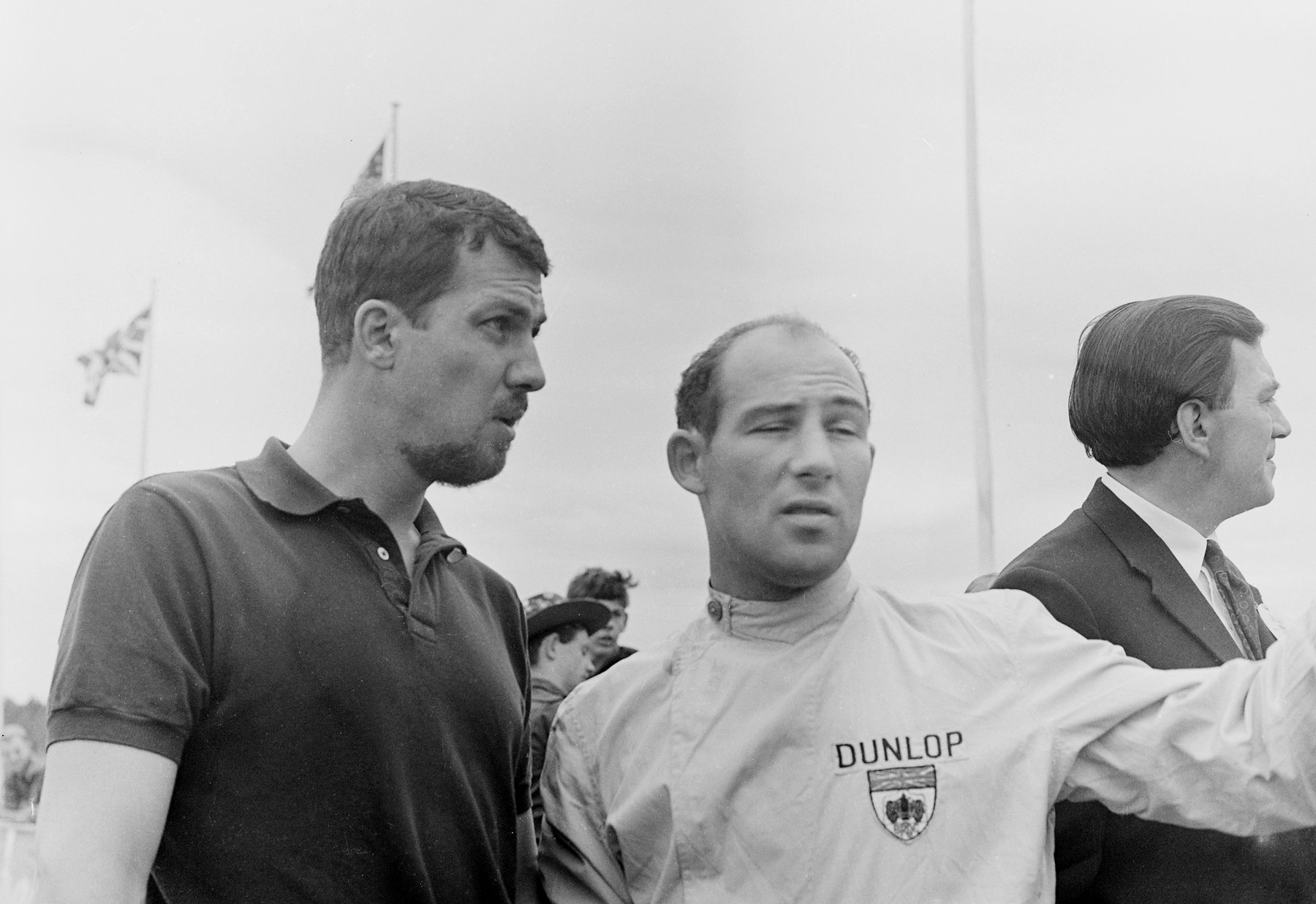
A week later, on 14 August, he was back in Grands Prix, on the Boavista street circuit at Oporto. Motor Sport found his injuries less serious than the popular press had made out. He ran 2nd and 3rd behind Dan Gurney and John Surtees until, on lap 19, the engine went on to three cylinders, and three stops followed. On his 51st lap he locked his front brakes at a sharp left-hander, stalled in the escape road, turned the car round and restarted it downhill, against the direction of the race. For that he was disqualified. On the same circuit two years before, his evidence to the stewards had kept Mike Hawthorn’s 2nd place.
At Goodwood on 20 August he won the Tourist Trophy, his sixth, in the short-wheelbase Ferrari 250 GT that Walker entered with Dick Wilkins, painted Walker’s dark blue. He beat everyone away at the Le Mans start, swapped the lead with Roy Salvadori’s Aston Martin, made three stops for tyres, and won. He was racing on an American competition licence: in April he had lost his British driving licence for a year, after a road accident in which no one else was hurt. Motor Sport made the point in its report: “Moss, driving an Italian car on a US competition licence, had proved yet again that he is the best driver on the circuits today.”
The British teams stayed away from the Italian Grand Prix, which was to be run on Monza’s combined road and banked circuit, and Walker did not enter. Moss went on winning elsewhere: a Formula Two race at Zeltweg in Austria in Walker’s Porsche on 18 September; the International Gold Cup at Oulton Park in the Lotus on 24 September, where after a poor start from pole he sat close behind Brabham’s sliding Cooper, first on one side and then the other, until he passed it on the way to Knickerbrook and drew away; a Formula Libre race at Watkins Glen on 9 October; and the Pacific Grand Prix at Laguna Seca on 23 October, in the Lotus 19.
Riverside, 20 November
The championship ended in California, at Riverside, over 75 laps of a circuit of 3.275 miles, with Brabham already champion. Sand storms blew across the desert during practice. Moss took pole in 1:54.4, and when he broke a Colotti gearbox on the Saturday Walker had a spare car ready. Before the start he was uneasy: a drive-shaft of John Surtees’s works Lotus had broken in practice, and the works cars had all been given new ones, while his own Lotus ran on an old pair that looked doubtful.
Brabham led. On lap 4 fuel from his overfull tank caught fire on the exhaust and scorched his back, and from the fifth lap Moss led, with Bonnier, Ireland and McLaren behind him. He won by 38 seconds from Ireland.
Three weeks before the race Sports Illustrated had weighed the two of them up, as Moss and Brabham tells. Brabham, in his own book, went further: “Moss is the greatest driver of all time,...better than Fangio.”
The wins went on to the end of the year: the Nassau Tourist Trophy in Walker’s Ferrari on 27 November, the Cape Grand Prix at Killarney on 17 December and, on 27 December, from pole, the South African Grand Prix at East London, both in a Porsche. For 1961 the Grand Prix formula changed to engines of 1½ litres, a formula that would favour Ferrari.
1960 · The champion
As fast as necessary
He is not what I would call a passionate driver. This makes him a very formidable competitor. He is always on form. He is always fast. He is a calculating driver. He is an intelligent and misleading driver. He will run a race as fast as necessary and no faster… I’m temperamental and I know it. Not when I’m racing, mind you, but away from the circuit things can upset me. Nothing upsets Jack.
1960 · Race by race
Race by race
| Rd | Grand Prix | Grid | Res. | Pts |
|---|---|---|---|---|
| 1 | ArgentineIn Trintignant’s car, No. 38 | 1 | 3 FL | 0 |
| His own car, No. 36: retired after 40 laps (suspension). Trintignant’s No. 38: 3rd. 0 points: from 1958 a shared drive scored no points. On pole; a poor start dropped him to 8th, he fought back to lead, then his suspension failed; McLaren won. | ||||
| 2 | Monaco | 1 | 1 | 8 |
| Walker had bought him a Lotus 18 for Monaco; on pole by a second; he led from lap 17, lost the lead to Brabham, regained it, and stopped to refix a plug lead before winning by 52.1s from McLaren; the first championship win for a Lotus. | ||||
| 4 | Dutch | 1 | 4 FL | 3 |
| On pole; on lap 17 a piece of kerb thrown up by Brabham’s Cooper punctured a tyre and damaged a hub; after the stop he charged back to 4th. | ||||
| 5 | Belgian | — | WD | — |
| Withdrew after crashing in practice. In Saturday practice a rear stub axle broke at Burnenville, a curve taken at over 130 mph, and he was thrown from the car and injured; he missed this and the next two championship races; in the race Chris Bristow and Alan Stacey were killed in separate accidents. | ||||
| 8 | Portuguese | 4 | DSQ | 0 |
| Drove against the direction of the race. His return after Spa; ran 2nd until plug trouble dropped him back; on his 51st lap he stalled in an escape road and restarted downhill against the direction of the race, for which he was disqualified, two years after defending Hawthorn on the same circuit for a similar act. | ||||
| 10 | United States | 1 | 1 | 8 |
| On pole; he won from Innes Ireland, with Brabham already champion. | ||||
| Season | 19 | |||
Red rule: a win. Bold grid figure: pole position. Broken rule and half-disc: a shared drive, the car changing hands. FL: fastest lap. WD: withdrawn. DSQ: disqualified.
1960 · The other races
The other races
| Race | Res. |
|---|---|
| South African Grand Prix | 2 |
| Fastest lap. East London. | |
| New Zealand Grand Prix | Ret |
| Clutch; fastest lap. Ardmore. | |
| Cuban Grand Prix | 1 |
| Havana, for Camoradi USA. | |
| Gran Premio di Siracusa | Ret |
| Engine, lap 27; fastest lap, record. Syracuse, for R.R.C. Walker. | |
| Sebring Four Hours | 2 |
| For Donald Healey Ltd. | |
| Sebring 12 Hours | Ret |
| Transmission, 136 laps. With Dan Gurney, for Camoradi USA. | |
| Grand Prix de Bruxelles (two heats) | 2 |
| Aggregate: 1st and 3rd in the heats. Heysel, for R.R.C. Walker. | |
| Glover Trophy | 2 |
| Fastest lap. Goodwood, for R.R.C. Walker. | |
| Fordwater Trophy | 1 |
| Goodwood, for Equipe Endeavour. | |
| BARC Aintree 200 | 1 |
| From pole. For R.R.C. Walker. | |
| BRDC International Trophy | Ret |
| Front wishbone, 34 laps; pole. Silverstone, for R.R.C. Walker. | |
| ADAC 1000 km | 1 |
| Nürburgring, with Dan Gurney, for Camoradi USA. | |
| Kanonloppet sports-car race | 1 |
| Karlskoga, for Yeoman Credit / BRP. | |
| RAC Tourist Trophy | 1 |
| Goodwood, for R.R.C. Walker and Dick Wilkins. | |
| Redex Trophy | 1 |
| Brands Hatch, for R.R.C. Walker. | |
| Flugplatzrennen | 1 |
| Zeltweg, for R.R.C. Walker. | |
| International Gold Cup | 1 |
| Pole. Oulton Park, for R.R.C. Walker. | |
| Gran Premio di Modena | Ret |
| Valve gear; lap record. For Reg Parnell (entry). | |
| Formula Libre race | 1 |
| Watkins Glen, for R.R.C. Walker. | |
| 200-mile sports-car race | Ret |
| Axle. Riverside, for British Racing Partnership. | |
| Pacific Grand Prix | 1 |
| Laguna Seca, for British Racing Partnership. | |
| Nassau Tourist Trophy | 1 |
| For R.R.C. Walker. | |
| Governor’s Trophy | 39 |
| Classified. Nassau (Oakes Field). | |
| Nassau Trophy | 44 |
| Classified. | |
| Cape Grand Prix | 1 |
| Killarney. | |
| South African Grand Prix | 1 |
| Pole. East London. | |
Red rule: a win.
1960 · Key dates
Key dates
Argentine Grand Prix: pole; 3rd in Trintignant’s car after his own breaks.
Wins the Cuban Grand Prix in Camoradi’s Maserati Tipo 61.
Loses his driving licence for a year after a road accident in which no one else is hurt; he keeps racing on an American competition licence.
Wins the Nürburgring 1000 km with Dan Gurney in the Tipo 61.
Wins the Monaco Grand Prix in Walker’s Lotus 18: the first championship win for Lotus.
Dutch Grand Prix: 4th after a puncture, with the fastest lap.
Crashes in Saturday practice for the Belgian Grand Prix at Spa when a rear stub axle breaks; the 1960 report gives a broken nose, back injuries and cracked bones in both legs, later accounts both legs broken and three vertebrae crushed.
Wins his comeback race, the sports-car Kanonloppet at Karlskoga, in a Lotus 19.
Portuguese Grand Prix: disqualified for driving against the direction of the race.
Wins the Tourist Trophy at Goodwood in Rob Walker’s Ferrari 250 GT SWB.
Wins the International Gold Cup at Oulton Park in a Lotus 18.
Wins the United States Grand Prix at Riverside.
Wins the South African Grand Prix at East London in a Porsche.
Sources
F1DB, release v2026.15.1, 27 September 2026: results, grids, qualifying times, fastest laps, entrant and points. github.com
Jolpica F1 API, 1960 driver standings and Moss’s 1960 results. api.jolpi.ca
RacingSportsCars, “Stirling Moss (GB): all results”, with the race page for the Sebring 12 Hours, 1960. racingsportscars.com
Silhouet, “1960 Non-World Championship Formula One Races”. silhouet.com
Motor Sport, reports of 1960: “The Argentine Temporada”, March; “The Cuban Grand Prix” and “Gran Premio Siracusa”, April; “Matters of Moment” and “The Bruxelles Grand Prix”, May; D. S. Jenkinson, “Continental Notes”, “The Aintree ‘200’” and “Innes Ireland drives brilliantly to win BRDC International Trophy race”, June; Jenkinson, “XVIIIth Grand Prix of Monaco”, “The Dutch Grand Prix”, “The Grand Prix of Belgium” and “The ADAC 1,000-kilometre race”, July; “Matters of Moment”, August; “Karlskoga, Sweden”, Jenkinson, “Portuguese Grand Prix”, and “The TT of tyre changes”, September; Jenkinson, “The XX Italian Grand Prix”, October; “Three Formula 2 races” and “Splendid finale at Oulton Park”, November; “2nd American Grand Prix”, December. motorsportmagazine.com
David Tremayne, “Stirling Moss interview: the F1 king they never crowned”, Motor Sport, November 1994. motorsportmagazine.com
Simon Taylor, “Lunch with… Stirling Moss” (2006), reprinted in Motor Sport, June 2020; and “The world according to Stirling Moss: from Fangio to Ferguson”, Motor Sport, October 2009. motorsportmagazine.com
Andrew Frankel, “Stirling Moss: more than Mr Motor Racing”, and Damien Smith, “Stirling Moss: the legend”, Motor Sport, June 2020; Damien Smith, “Lotus 18 vs Cooper T53: go low, aim high”, Motor Sport, 15 September 2025. motorsportmagazine.com
Goodwood Road & Racing, “The Glover Trophy: Goodwood’s illustrious Formula 1 contest” and “Obituary: Sir Stirling Moss 1929–2020”. goodwood.com
Sports Illustrated, “Jack the Reluctant Ripper”, 31 October 1960, via the Wayback Machine. web.archive.org