Part Two · The man
XIII
The sportsman What a racing driver meant to Britain after the war
How Stirling Moss became a national figure in post-war Britain: the British cars he chose, Oporto in 1958, the press, and why never being champion stuck to him.

XIII · The sportsman
A household name
Some time in the 1970s, by the story his family and Mercedes-Benz tell, a London policeman stopped a car that had overtaken too boldly and asked the driver who he thought he was: Stirling Moss? It was Moss, and he said so. The story is told in The Last Blast, a film Mercedes-Benz made in 2021, and no record of the stop has been found. But the question is real, and in time it fastened on a man who had last raced at the front in 1962 and had never been World Champion.
This chapter is about how that happened. He arrived just after the war, when, as later writers saw it, a tired country wanted a hero. He drove British cars when there were British cars worth driving, and was seen to want to. At Oporto in 1958, with the title at stake, his evidence saved his rival’s points. He let the press and the public in, all his life. And the championship he never won, which might have been a footnote, he turned into part of the story himself.
XIII · The sportsman
After the war
He began racing in 1948, in a Britain that was still on rations, and writers since have set him against that background: the teenage “Boy Wonder” in a little British Cooper, taking on the Continentals. Damien Smith, writing in Motor Sport in 2020, called him a beacon out of the post-war gloom. Mark Hughes, in the same magazine’s obituary, put it in a sentence.
He was more than just a very great racing driver though. He was the embodiment of Britain’s emergence, post-World War Two, as a force that would soon come to dominate international racing for the first time.
He was also, in a country that still admired the gifted amateur, openly a professional. Ken Gregory, who managed him, thought him the first driver whose only income was racing, and Smith wrote that if Moss was going to risk his life, he expected at least a decent living, in line with a top lawyer’s. In time he had a second nickname, “Mr Motor Racing”, and a public far wider than the readers of the motoring magazines.
It is fair to call him the first British motor-racing star of the television age, though no source puts it in those words, and Mike Hawthorn appeared on the BBC’s Sportsview too. In April 1959 the BBC made him the subject of This Is Your Life. On 12 June 1960 he spent 30 minutes being questioned by John Freeman on Face to Face, six days before he crashed in practice at Spa, and what Freeman made of him is in What they said. In December 1961 he was the BBC’s Sports Personality of the Year. Radio carried his races too: Nigel Roebuck, later a motor-racing writer, heard the Monaco Grand Prix of 1961 as a schoolboy, on Raymond Baxter’s commentary.
When he crashed at Goodwood on Easter Monday 1962, it was national news for months. Simon Taylor remembered the BBC giving radio bulletins on his condition every hour; David Tremayne wrote that the specialist papers held back but the dailies did not, and that the Daily Express kept a photographer at Goodwood in case Moss went testing there in secret.
XIII · The sportsman
British cars, when there were any
His World Championship cars
- 1951–1953
- HWM, ERA, Connaught, Cooper-Alta
- 1954
- Maserati 250F
- 1955
- Mercedes-Benz W196
- 1956–1957
- Maserati 250F
- 1957–1958
- Vanwall
- 1958–1961
- Cooper and Lotus, for Rob Walker
- 1959
- BRM P25, for the British Racing Partnership
- 1961
- Ferguson P99
His words to Simon Taylor in 2006 about British green against Italian red open this book. Twelve years earlier he had given Tremayne a plainer version, with the dates in. He had wanted a British car from the start, he said, and after the war there was none worth having; John Heath’s HWM was the first. He stayed with British cars while they lasted, through the ERA and the Connaught of 1952 and the Cooper-Alta of 1953, and when they gave out he bought a Maserati 250F for 1954, because there was nothing else.
For 1955 Mercedes-Benz signed him, and he went above all for Fangio, who led the team. Not everyone at home approved: “I got a lot saying that I shouldn’t drive for the Germans, which I could understand.” He answered them, and argued his case.
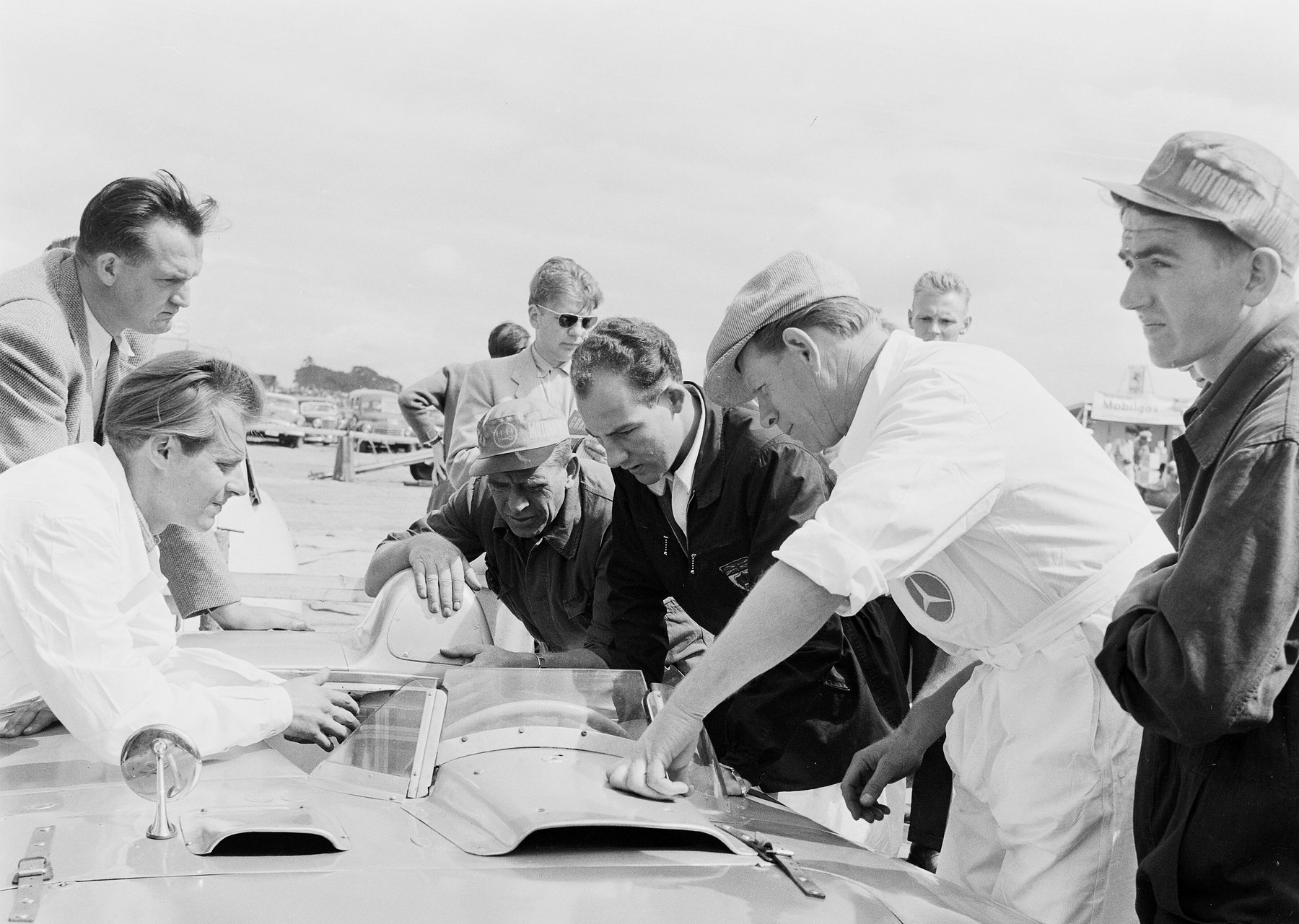
In 1956, Mercedes-Benz having withdrawn, he drove for Maserati’s works team. Then, as he put it to Tremayne, he got the one thing he had wanted most, an English car. Tony Vandervell’s Vanwall won at Aintree on 20 July 1957, with Moss in the car Tony Brooks had started: the first win in a World Championship round for British drivers in a British car. Wins at Pescara and Monza followed, at Monza in front of the Italians.
In Argentina in 1958, and then from 1959 to 1961, he drove for Rob Walker, a private entrant, in British cars painted in Walker’s dark blue. Cooper and Lotus both won their first World Championship races with him, in Walker’s cars and not their own: Cooper at the Buenos Aires Autodrome in 1958, with a T43, and Lotus at Monaco in 1960, with an 18. As for the pleasure of winning, he said, “there’s nothing better than hearing God Save the Queen played because you’ve won”.
None of this made him a patriot in every car. In sports cars he won for Jaguar and Aston Martin, but also for Maserati, Mercedes-Benz and Porsche, and in Walker’s colours he won the Tourist Trophy of 1960 and 1961 in a Ferrari. Ferrari was a grudge as much as a principle. In 1951, by his own account, he went to Bari for a car Enzo Ferrari had offered him and found that it had gone to Piero Taruffi; he would not drive for the works team after that, and when he agreed at last, for 1962, it was for a car run by Walker and painted in Walker’s blue, which Goodwood ended before it was delivered. Gregory thought that what kept him in British teams was less the flag than their way of working.
On the day Moss died, Jackie Stewart said that he had never won the title only because he always wanted to drive a British car. That is true at most in part. He lost to Fangio three times in a Mercedes-Benz, a Maserati and a Vanwall; in 1958 he lost by a point in a British car that kept breaking; and in the years after that he chose Walker’s private team over the works drives he could have had.
XIII · The sportsman
Oporto, 1958
The race is told in 1958, and the rivalry in Moss and Hawthorn. The facts beneath it are few. On 24 August 1958 Moss won the Portuguese Grand Prix at Boavista. After Moss had taken the flag, Hawthorn, running 2nd, spun, and got his Ferrari going again on the footpath, facing the wrong way round; he was disqualified, and at 11 o’clock that night the stewards gave him back his place, on the word of Moss, who had seen it, that Hawthorn had endangered no one. The 2nd place was worth 6 points, and the fastest lap 1 more; with them, Hawthorn was champion in October by a single point, 42 to 41.
The sportsmanship was praised at the time. After the season ended at Casablanca, Autocar held up the friendship between the two rivals as proof that motor racing was not the cut-throat business some supposed. That Sunday the schoolboy Roebuck came late into chapel with a transistor radio at his ear, waiting for the result from Morocco: Moss had won, and Hawthorn was champion.
Then the story grew. The report of 1958 has Moss confirming, as a witness, what he had seen. By 1994 his memory was that he had argued Hawthorn’s case himself, telling the stewards that the escape road was still the track, and Tremayne wrote that he had stepped forward of his own accord. In 1998 Roebuck had him interceding, arguing that Hawthorn had broken no rule. By 2009 Moss remembered Hawthorn being given a push. In 2012 Quattroruote told its readers that Hawthorn had been disqualified for following Moss’s advice, shouted to him, to restart against the direction of the race; nothing in the report of 1958 says so. In 2020 one obituary had him pleading the case before the stewards, and another had Hawthorn accused of reversing on the track, which he had not done. Moss himself did not waver on the one thing that mattered to him. To Quattroruote, in 2011:
Era l’unica cosa corretta da fare, questo è uno sport. E nello sport bisogna essere corretti fino in fondo. … A me bastava di aver meritato il rispetto dei colleghi, più che la gloria.
It was the only right thing to do; this is a sport. And in sport you have to be fair all the way. … For me it was enough to have earned the respect of my colleagues, more than the glory.
Nor did he lose the title only by being fair. In the same race he misunderstood a pit board telling him that Hawthorn had set a lap record, and did not go for the point the fastest lap was worth; his Vanwall retired five times that year, and Hawthorn kept on scoring. Had they finished level, Moss’s four wins to Hawthorn’s one would have made him champion. But Oporto is the part that people remember.
He was content to be known, he often said, as the man who never won the world championship: a way of distinguishing him from those of lesser gifts but better luck who had actually succeeded in winning motor racing’s principal honour. But it was the manner in which Stirling Moss, who has died aged 90, effectively handed the trophy to one of his greatest rivals that established his name as a byword for sporting chivalry, as well as for speed and courage.
XIII · The sportsman
The press and the public
The newspapers were not always kind. In 1959 and 1960, when Walker’s cars kept breaking with Moss in the lead, he was called a car wrecker, and at Zandvoort in 1960 he told Walker that he was tired of it and would not take the lead any more. He soon decided that the press could say what it liked. He appeared in advertisements, too, and one of them was for cigarettes.
I’d always smoked a bit. I did an advert for Craven A, which used to say I don’t smoke often but when I do I’m choosy, I smoke Craven A. That was worth, probably, about 50 quid a year, I suppose. I can’t remember for sure, but I do know that my contract with Astons was £50 a year.
His private life was public, and he let it be. His appeal, Richard Williams wrote in his obituary, owed something to his willingness to let feature writers and television cameras into his gadget-filled house in Shepherd Market, in Mayfair, and something to “the devil-may-care charisma formerly associated with Battle of Britain fighter pilots”. By his own count there were hundreds of girlfriends before his third marriage, and he married three times, as After racing tells. Damien Smith thought him, for all the late nights, more polished and more professional than Hawthorn.
In April 1960 a road accident in which nobody else was hurt cost him his British driving licence for a year, and he went on racing on an American competition licence, as the 1960 season tells. He stayed in the telephone book all his life, and he answered his letters, every one with a return address. His reason was a rule of his own: “the moment you take accolades from the public you owe something”. How he lived by it after racing is in After racing.
XIII · The sportsman
Never champion
He was runner-up in the World Championship four years running, from 1955 to 1958, and 3rd in each of the next three, and he won 16 World Championship Grands Prix. Three of the titles went to Fangio, one to Hawthorn, two to Jack Brabham and one to Phil Hill. It might have been remembered as bad luck. That it was remembered as something else was, in the first place, his own doing.
In Ken Purdy’s book, published in 1963, he explained why he did not mind. Hawthorn had been killed on the road near Guildford in January 1959.
Because I’d rather go down in history as the man who never won the championship, than as the man who won it once. If I won it once, what of that? Mike Hawthorn won it once. If one wins it twice, does that mean one is a better driver than Mike? I think Mike Hawthorn was a splendid person, he did a lot for motor racing, I liked him, and I very much indeed wish he were still with us. But I didn’t consider him a very consistent driver. … I had more respect for Mike as a man than as a driver.
Fangio, retiring, had given Moss a clock inscribed to the future World Champion, as Moss and Fangio tells. After 1958, by his own account, his attitude changed. He had believed that year that he ought to be champion, had lost to Hawthorn by a point, and decided after it to go out and enjoy himself. Mark Hughes thought the defeat cured him of worrying too much about the title: winning races, best of all as the underdog, meant more.
In old age he embraced it. In 1994 he told Tremayne that he was better off without the title, because he was the man people said should have won it. The Associated Press quoted another line of his when he died: “I hope I’ll continue to be described as the greatest driver who never won the world championship, but it doesn’t really matter … The most important thing for me was gaining the respect of the other drivers and I think I achieved that.” (attributed) The obituaries took his side, Hughes’s most of all.
The fact that the list of F1 world champions does not feature his name is more an indictment of the championship than of him.
There was more to it than the story of 1958. He outlived the era by almost 60 years, and spent them in public. A bronze statue of him at Mallory Park, unveiled in 2006, calls him the people’s champion, as Legacy tells. And the record still holds, as Records counts it: no driver who never won the title has won more World Championship Grands Prix than his 16.
XIII · The sportsman
The policeman’s question
Where the question came from, nobody has found out, but its roots go back a long way. On the evening of his first World Championship win, at Aintree in 1955, a motorcycle policeman on the road home was already calling Nigel Roebuck’s speeding father by Moss’s first name, as Roebuck remembered it and 1955 tells. When the BBC made him the subject of This Is Your Life in 1959, the surprise began with an actor dressed as a speed cop pulling his car over, and the presenter joked about what Moss was said to have told real ones. Then came the year without a licence.
The question itself, word for word, has not been found in print before 1994, in Tremayne’s interview.
…Moss has retained the public affection and the popularity that still prompts police officers who stop speeding motorists to enquire with what passes for humour in such circles: ‘Who do you think you are, Stirling Moss?’ The name is etched on the public psyche as indelibly as Stanley Matthews and Henry Cooper.
It did not wear out. In 2006 Simon Taylor wrote that if you cut up a London cabbie, Moss was still the name you would hear, not Mansell, Stewart or Hunt. In 2020 Damien Smith listed the champions who had never replaced him in it: Graham Hill, Jim Clark, John Surtees, Jackie Stewart, James Hunt, Nigel Mansell, Damon Hill and Lewis Hamilton. Not everything told about it is true. The story that a palace guard asked it of the newly knighted Sir Stirling, and got a crisp reply, has no source at all, and is among the doubtful lines in his words.
The last word went to a champion. At the Service of Thanksgiving for Moss in Westminster Abbey, on 8 May 2024, Jackie Stewart told the congregation about the time a London policeman stopped him for speeding.
I stopped, wound down the window, and he said ‘who do you think you are, Stirling Moss?’ And I had just won the world championship
The question never changed.
Sources
David Tremayne, “Stirling Moss interview: the F1 king they never crowned”, Motor Sport, November 1994. motorsportmagazine.com
Damien Smith, “Stirling Moss: the legend”, Motor Sport, June 2020, quoting Ken W. Purdy, All But My Life (William Kimber, 1963). motorsportmagazine.com
Mark Hughes, “Sir Stirling Moss obituary: the Boy Wonder who defined his era”, Motor Sport, 12 April 2020. motorsportmagazine.com
Andrew Frankel, “Stirling Moss: more than Mr Motor Racing”, Motor Sport, June 2020. motorsportmagazine.com
Richard Williams, “Sir Stirling Moss obituary”, The Guardian, 12 April 2020. theguardian.com
Simon Taylor, “Lunch with… Stirling Moss” (2006), and “Stirling Moss at 80: estate agent or MP?”, Motor Sport, October 2009. motorsportmagazine.com
Gordon Cruickshank, “Ken Gregory and Stirling Moss: a winning partnership”, Motor Sport, October 2009. motorsportmagazine.com
Denis Jenkinson, “VII Grande Premio de Portugal”, Motor Sport, October 1958. motorsportmagazine.com
Nigel Roebuck, “Mike Hawthorn: Nigel Roebuck’s F1 legends”, Motor Sport, December 1998, quoting The Autocar of 1958; and “Legends: Rob Walker”, Motor Sport, June 2002. motorsportmagazine.com
Nigel Roebuck, “Legends”, Motor Sport, February 2003. motorsportmagazine.com
Simon Arron, “Sir Stirling Moss at 90: a true racer”, Motor Sport, September 2019. motorsportmagazine.com
Gian Luca Pellegrini, “Le grandi interviste: Stirling Moss”, Quattroruote (interview of 2011, first published January 2012). quattroruote.it
“Matters of Moment”, Motor Sport, May 1960. motorsportmagazine.com
Big Red Book, “This Is Your Life: Stirling Moss”, reproducing Richard Williams, The Boy: Stirling Moss: A Life in 60 Laps (2021). bigredbook.info
BBC Programmes, “Face to Face: Stirling Moss” (1960). bbc.co.uk
BBC Sport, “Sir Stirling Moss: motor racing legend dies aged 90 after long illness”, 12 April 2020. bbc.co.uk
Associated Press obituary, 12 April 2020, as published by Fox News. foxnews.com
“Motorsport world pays tribute to Stirling Moss”, GrandPrix247, 12–13 April 2020. grandprix247.com
mercedesblog, “The Mercedes-Benz 300 SLR ‘722’ parades through London in tribute to Sir Stirling Moss” (2021), on The Last Blast. mercedesblog.com
The Sporting Statues Project, University of Sheffield, “Sir Stirling Moss: Mallory Park Circuit”. offbeat.group.shef.ac.uk
evo, “Sir Stirling Moss remembered at Westminster Abbey memorial”, 8 May 2024; Reuters, “Stirling Moss hailed as true racer at memorial service”, via RNZ, 9 May 2024. evo.co.uk, rnz.co.nz