Part One · The life
V
The sports cars Seven Tourist Trophies and 10 starts at Le Mans, 1950–1962
Stirling Moss in sports cars, 1950–1962: seven Tourist Trophies, four Nürburgring 1000 km wins, 10 Le Mans starts without a win, and Rob Walker’s Ferrari.
V · The sports cars
The Nürburgring, 7 June 1959
The start of the Nürburgring 1000 km was chaotic, and out of it Stirling Moss went so far ahead in his Aston Martin DBR1 that he had come over the horizon, gone past the pits and round the South Curve before Dan Gurney arrived. Aston Martin had sent a single car, with Jack Fairman as his co-driver, and Moss drove the first 17 laps without stopping. On his eighth he broke the lap record of the Nürburgring, in 9 min 41 s, and on his eleventh he broke it again, in 9 min 32 s.
Then it rained. Fairman spun into a ditch, climbed out and pushed it free, and the lead was gone to the Ferraris. Moss could have wept, Motor Sport’s Denis Jenkinson reported. As soon as Fairman had sat in the car for the minimum time, Moss pulled him out by the arm, jumped in and was away. He caught the Ferraris and won, in 7 h 33 min 18 s, at 132.8 km/h (82.5 mph).
While Moss was showing himself to be the absolute sports-car master on the Nurburgring, others were vainly trying to keep up … surely it would make winning more easy if they found Moss a co-driver of higher calibre. To run a single-handed race two years running is enough to take years off his life.
It had been the same the year before, when he and Jack Brabham won the race in a DBR1 with Moss at the wheel for most of it. Jenkinson’s report had a sting in its tail: “How rude can you get — Moss had disappeared from the Nurburgring bare minutes after the race finished, leaving his co-driver to collect the silverware that evening.”
It was the third of his four wins in the race, and his second for Aston Martin. Three months later, in the Tourist Trophy, he would win the World Sports Car Championship for the team.
V · The sports cars
Arguably better
By most judgements, sports cars were where Moss was at his best. Motor Sport, looking back, judged him arguably better in them than in a Grand Prix car, because sharing a car with a team took some of the mental load off him. He raced them for Jaguar, Mercedes-Benz, Maserati, Aston Martin and Porsche, and for private teams in America and Britain; he won in British, German, Italian and American-entered cars alike, and he drove Ferraris only for private entrants, never for the factory.
He called sports-car racing his relaxation, relatively speaking. It was also where many of the deaths of his era happened around him: at Dundrod in 1951 and 1955, at Le Mans in 1955 and at Havana in 1958. They are recorded below, with the races in which they happened.
It began with a borrowed car. On 16 September 1950 Tommy Wisdom of the Daily Herald lent him his Jaguar XK120 for the RAC Tourist Trophy at Dundrod, and in a gale and torrential rain, the day before his 21st birthday, he won it; the chapter on the 500s tells that day. Jaguar took him into its works team for 1951, and he led it until the end of 1954.
V · The sports cars
Jaguar, 1951–1954
He went back to Dundrod in 1951 with the new C-type and won the Tourist Trophy again, non-stop, at an average of 83.55 mph (134.46 km/h). On the way he raised the lap record to 82.91 mph and then to 83.43 mph, 22 seconds a lap faster than he had gone in the XK120 in the rain the year before. Motor Sport noted the company he now kept: “Moss shares with Nuvolari and Dixon the distinction of twice winning the T.T. race.” On the first lap Eric Winterbottom’s Frazer Nash had overturned at Wheeler’s Corner, and Winterbottom died.
The C-type gave him an early win on disc brakes, in Tommy Wisdom’s car at Reims-Gueux in 1952, a race often said to be the first major international one won by a car with them, and in 1953 he and Peter Whitehead won the Reims 12 Hours. The Tourist Trophies of 1953 and 1954, both shared with Peter Walker, brought a 3rd place, though one newspaper of the day made it 4th, and, in 1954, a D-type that lost its oil pressure and finished low in the order.1

His one sports-car win of 1954 came in a much smaller car. At Sebring on 7 March he and Bill Lloyd shared Briggs Cunningham’s 1,452cc OSCA MT4 in the 12 Hours. In practice he lapped it consistently well under 4 minutes. In the race the big cars broke, Lancias, Ferraris and Aston Martins alike, while the little OSCA kept going in spite of a slipping clutch, and when Taruffi’s leading Lancia seized with an hour to go it won, on distance and on the index of performance.2
V · The sports cars
Le Mans: 10 starts, no win
Le Mans began with the drivers running to their cars, and Moss worked at it: “I used to practice time and time again for half an hour or so: rushing across, jumping in, turning on the ignition. I was a fast runner over short distances.” He started the 24 Hours 10 times, every year from 1951 to 1959 and again in 1961, and never won. Twice he was 2nd; the other eight times the car retired or, in 1955, was withdrawn. He was usually the team’s hare, sent off to break the opposition, and he led early in 1951, 1952, 1953, 1958 and 1959.3
In 1951, in the C-type’s first race, he and Jack Fairman led within the first half-hour and set a lap record early on before the engine lost its oil pressure in the night. In 1952 Jaguar fitted low-drag bodies, because Moss had seen how fast the Mercedes-Benz 300 SL was in the Mille Miglia; the three cars overheated and were out within three and a half hours. In 1953, with Peter Walker, he led the first hour, lost time in the pits changing plugs, and climbed back to 2nd, 4 laps behind Tony Rolt and Duncan Hamilton’s winning Jaguar; Jaguars were 1st, 2nd, 4th and 9th. In 1954 the D-type he shared with Walker kept up with the Ferraris at first, timed at 278 km/h (173 mph) through the measured kilometre, and retired with failing brakes.
In 1955 he shared a Mercedes-Benz 300 SLR with Juan Manuel Fangio. On the first evening came the accident that killed Pierre Levegh, in another of the team’s cars, and more than 80 spectators. The race went on, and at about two in the morning, with Fangio and Moss 2 laps in the lead, Mercedes-Benz withdrew its cars. The 1955 season tells that night.
In 1956, run late, in July, he and Peter Collins drove a works Aston Martin DB3S, not fast enough for the Jaguars. Ecurie Ecosse’s D-type led from five o’clock on the first afternoon, and the rest of the race was a game of cat and mouse between Flockhart and Sanderson in the Scottish car and Moss and Collins in the Aston. Only 14 of the 49 starters were still running at the end, and the Aston was 2nd. In 1957 Maserati built a closed coupé on the 450S at his urging, its body designed by Frank Costin and made by Zagato. Fangio took one look inside and declined, Harry Schell took his place, and the car split an oil pipe and then seized a rear universal joint. Moss called it, by one account, “a genuinely bad car” (attributed).
It is impossible to over-estimate the part played by Moss in our success at Le Mans.
In 1958 he ran away from the field in a DBR1 with Brabham until, after 2 hours 10 minutes, the engine broke and he stopped at Mulsanne; Brabham never drove. In 1959 the hare’s role was an order. John Wyer, Aston Martin’s team manager, gave Moss’s car a higher-compression engine on four main bearings instead of seven, called it semi-expendable, and sent him off with Fairman to break the Ferraris. After about 70 laps the engine failed. By then, Wyer judged, Moss’s pace had broken Jean Behra and Gurney’s Ferrari, and the race went to Roy Salvadori and Carroll Shelby.
He missed 1960, mending from his crash at Spa. His last Le Mans, in 1961, was in Rob Walker’s Ferrari 250 GT, run under the North American Racing Team’s entry, with Graham Hill. It set a lap record for GT cars and was 3rd overall in the ninth hour, a private car among the works teams, when a fan blade broke and the engine lost its water. In 2019 he gave his own verdict on his Le Mans years: “I think my best achievement in the 24 Hours of Le Mans actually was meeting my wife there.” The ACO names her: Katie, his wife from 1957.
V · The sports cars
Mercedes-Benz, 1955
Fangio. E non è falsa modestia. Sulle Formula 1, almeno. Sulle Sport lo battevo spesso. Quando gli chiedevo perché preferisse le monoposto, mi rispondeva sempre che lui voleva vedere le ruote davanti. … La verità è che lui era totalmente concentrato sulla guida, con una costanza unica; poi era davvero veloce.
Fangio. And that’s not false modesty. In Formula 1, at least. In sports cars I often beat him. When I asked him why he preferred single-seaters, he always told me he wanted to see the front wheels. … The truth is he was totally concentrated on driving, with a unique consistency; and he was really fast.
The 300 SLR was a two-seater built from Mercedes-Benz’s Grand Prix car, and in it, in 1955, Moss won the jewels of his sports-car career. He won the Mille Miglia with Jenkinson in May. In the Eifelrennen at the Nürburgring and the Swedish Grand Prix at Kristianstad he was 2nd, both times to Fangio.

The Tourist Trophy at Dundrod fell on his 26th birthday, 17 September. He shared a 300 SLR with John Fitch, came through from low down the starting line to lead the first lap, survived a rear tyre bursting at 130 mph, and beat the Jaguar of Mike Hawthorn and Desmond Titterington when Hawthorn’s engine failed with 2 laps left. It was his third Tourist Trophy. Three drivers died in the race: Richard Mainwaring, whose Elva overturned and caught fire, and Jim Mayers and William Smith, in a crash of several cars at Deers Leap on the second lap.
The last race of the year, on 16 October, decided the World Sports Car Championship between Mercedes-Benz and Ferrari: the Targa Florio, 13 laps of the 72 km Madonie circuit in Sicily, 936 km in all, started two hours early so that it would finish in daylight. Moss shared No. 104 with Collins. On his fourth lap he went off into a field, close to a drop, and the Sicilian crowd manhandled the bent car back on to the road. Collins caught and passed everyone in 4 laps, went off too and wrecked the nose, and between them they won anyway, with Fangio and Kling 2nd. Moss brought the car home in failing light, a quarter of an hour before dark. Mercedes-Benz were champions, and then left racing.
V · The sports cars
Maserati, 1956–1957
Back at Maserati for 1956 as its team leader, Moss won in sports cars on four continents. The 300S, a 3-litre six, was another favourite of his. With Carlos Menditeguy he won the Buenos Aires 1000 km in January, the first round of the championship. At the Nürburgring in May his own car broke a rear spring, and Maserati put him and Behra into the car Taruffi and Schell had been driving. At its stop two mechanics changed the rear wheels while Moss filled the tank himself, and the car was away in 57 seconds; he then took as much as 6 seconds a lap from Fangio’s Ferrari, caught it and passed it to win. In November and December he won the sports-car Grand Prix at Caracas, the Australian Tourist Trophy at Melbourne and the Nassau Trophy in the Bahamas.
V · The sports cars
The wins of 1956
| Race | Res. |
|---|---|
| Ardmore sports-car race | 1 |
| For Porsche Distributors (Melbourne). | |
| Buenos Aires 1000 km | 1 |
| With Carlos Menditeguy, for Officine Alfieri Maserati. | |
| Goodwood Easter sports-car race (over 1,500 cc) | 1 |
| For Gilby Engineering. | |
| British Empire Trophy | 1 |
| Oulton Park. | |
| Nürburgring 1000 km | 1 |
| Own No. 5, with Behra: retired. With Taruffi, Schell and Behra, for Officine Alfieri Maserati. | |
| British GP meeting, sports-car race | 1 |
| Silverstone, for Maserati. | |
| Bari Grand Prix (sports cars to 3 litres) | 1 |
| Led throughout, fastest lap. For Maserati. | |
| Daily Herald International Trophy (over 1,500 cc) | 1 |
| Oulton Park, for David Brown Industries. | |
| Oulton Park, 1,500 cc sports cars | 1 |
| For Willment Speed Shop; “Les Leston’s Cooper-Climax”. | |
| Venezuelan Grand Prix | 1 |
| Caracas, for Officine Alfieri Maserati. | |
| Australian Tourist Trophy | 1 |
| Albert Park, Melbourne, for Maserati. | |
| Nassau Trophy | 1 |
| Oakes Field, Nassau, for William (Bill) Lloyd. | |
Red rule: a win.
V · The sports cars
The four-five
In 1957 Maserati had the 450S, a 4.5-litre V8, in January the most powerful sports-racing car in use, and by then a good deal less of a monster than when it first appeared. It was fast, and it failed him. In the Buenos Aires 1000 km he was more than 2 minutes ahead after 33 laps before Fangio took over and the transmission broke; Moss finished 2nd in a 300S as well. At Sebring in March he and Schell were 2nd in a 300S, behind Fangio and Behra in a 450S. In the Mille Miglia the 450S’s brake pedal broke soon after the start. In August, sharing Behra’s car, he won the Swedish Grand Prix at Kristianstad.
At Caracas on 3 November the season ended in ruin for Maserati. Moss crashed one 450S, then took over another that broke; he set the fastest lap, and Ferraris finished 1st, 2nd, 3rd and 4th. The works cars, V8 and six-cylinder, were left as charred wrecks, and at the end of the year Maserati withdrew its works team. Moss won the Nassau Trophy a month later in Temple Buell’s Ferrari 290 MM, the first of his wins in a Ferrari.
V · The sports cars
Aston Martin, 1958–1959
He had driven Aston Martins in 1956, between Maserati races, and he went back to them for two seasons. Moss remembered what praise from Wyer was worth: “He would never praise anybody … you really felt good!”
The DBR1, a 3-litre car, won the Nürburgring 1000 km three years running, the first time with Tony Brooks and Noel Cunningham-Reid, but was ill-suited to Le Mans. In 1958 Moss and Brabham won the Nürburgring race in one, and in September he and Brooks won the Tourist Trophy, now at Goodwood, at the head of three Astons that crossed the line almost abreast; he raised the sports-car lap record there three times, finally to 93.3 mph (150.2 km/h). In 1959 the Tourist Trophy, on 5 September, settled the championship.
He was on pole, and he was running to his car before the flag was fully raised; the whole field followed him. At a pit stop the car he shared with Salvadori caught fire as it was refuelled. Moss took over the car of Shelby and Fairman instead, and won: 224 laps in 6 hours, at 89.41 mph (143.89 km/h), credited to the three of them. Aston Martin, in spite of its ordeal by fire, were world sports-car champions. The reputation that followed him, of a driver who broke cars, Motor Sport later called debatable: he was the willing hare, and when an engine broke at Le Mans in 1958 Wyer was sure it had not been over-revved.4
V · The sports cars
Havana and the Birdcage
He raced three times in Cuba’s Grand Prix for sports cars. In 1957, on the Malecón in Havana, he led until his engine seized, then took over Schell’s Maserati, which broke a valve. In 1958 he drove a Ferrari 335 S for the North American Racing Team. A crash on the sixth lap, by most accounts, killed spectators; accounts of how many differ.5 Moss knew that only the clerk of the course could stop the race. When a red flag appeared at the scene of the crash, Masten Gregory, who was leading, slowed; Moss dropped into second gear 50 yards from the line, passed him and was declared the winner. He calmed Gregory by giving him half the prize money. The race had lasted 13 minutes.
In 1960, at Camp Columbia, he won it again, in the first race of the Maserati Tipo 61 that Lloyd “Lucky” Casner’s Camoradi team ran, the Birdcage, named for its frame of small tubes. At the Nürburgring on 22 May he and Gurney took it to his fourth win in the 1000 km, in mist, rain and fog. Moss drove the first 14 laps without a stop. Gurney lost the lead when an oil pipe broke, and fought back in the fog; Moss took the last stint, gained 12 seconds a lap, lap after lap, lapped in 9 min 37 s and won. The crowd was more than 250,000, and to Jenkinson it seemed that every American serviceman had come to see the blue-and-white Camoradi car. Moss said afterwards that he had enjoyed having a co-driver who could keep up the pressure.
Nassau, in the Bahamas, closed his year more than once. He won its Nassau Trophy in 1956 and 1957, its Governor’s Trophy in 1959 in an Aston Martin DBR2, and its Tourist Trophy in 1960 and 1961.
V · The sports cars
Rob Walker’s Ferrari
The Nassau Tourist Trophies were won, like the Goodwood ones, in the short-wheelbase Ferrari 250 GT entered by Walker and his partner Dick Wilkins, a right-hand-drive competition berlinetta in Walker’s dark blue and white. Whether he ran one car across the two years or two is not settled.6 Moss is said to have called the type the “Best GT car in the world” (attributed).
At Goodwood on 20 August 1960, in his first season in Walker’s Ferrari, he won his sixth Tourist Trophy: 108 laps in 3 h 1 min 43.2 s, at 85.58 mph (137.73 km/h), with Salvadori’s Aston Martin DB4 GT 2 laps behind. With a big enough lead, he listened to the race commentary on the Ferrari’s radio. On 19 August 1961 he won the seventh, from Mike Parkes in the Maranello Concessionaires’ car: 109 laps at 86.63 mph (139.41 km/h). In 1961 the car he raced won five of its six races with Moss or Graham Hill driving; Le Mans was the one it did not finish.
V · The sports cars
GT races, 1961
| Race | Res. |
|---|---|
| Sebring Four Hours | 5 |
| For John Sprinzel. | |
| Fordwater Trophy | 3 |
| Goodwood, for R. Wilkins and R.R.C. Walker. | |
| Le Mans 24 Hours | Ret |
| Broken fan blade, water lost. Circuit de la Sarthe, with Graham Hill, for North American Racing Team. | |
| GT race, British Empire Trophy meeting | 1 |
| Silverstone, for R.R.C. Walker and R. S. Wilkins. | |
| Peco Trophy | 1 |
| Brands Hatch, for R.R.C. Walker and R. S. Wilkins. | |
| RAC Tourist Trophy | 1 |
| Goodwood, for R.R.C. Walker. | |
| Tour de France Automobile | DNS |
| With Solomon, for R.R.C. Walker. | |
| Riverside Three Hours | 4 |
| With Jack Brabham, for Bud Rose Imports. | |
| Nassau Tourist Trophy | 1 |
| Also won the preliminary. For R.R.C. Walker. | |
Red rule: a win.
V · The sports cars
Number 7
His last sports-car win before the accident came at Nassau on 3 December 1961, in Walker’s Ferrari. Early in 1962 he drove for the North American Racing Team: 4th in the Daytona three-hour race in February in a 250 GT, and at Sebring in March, with Innes Ireland, disqualified for refuelling too early. For the Tourist Trophy in August he was entered in a Ferrari 250 GTO.
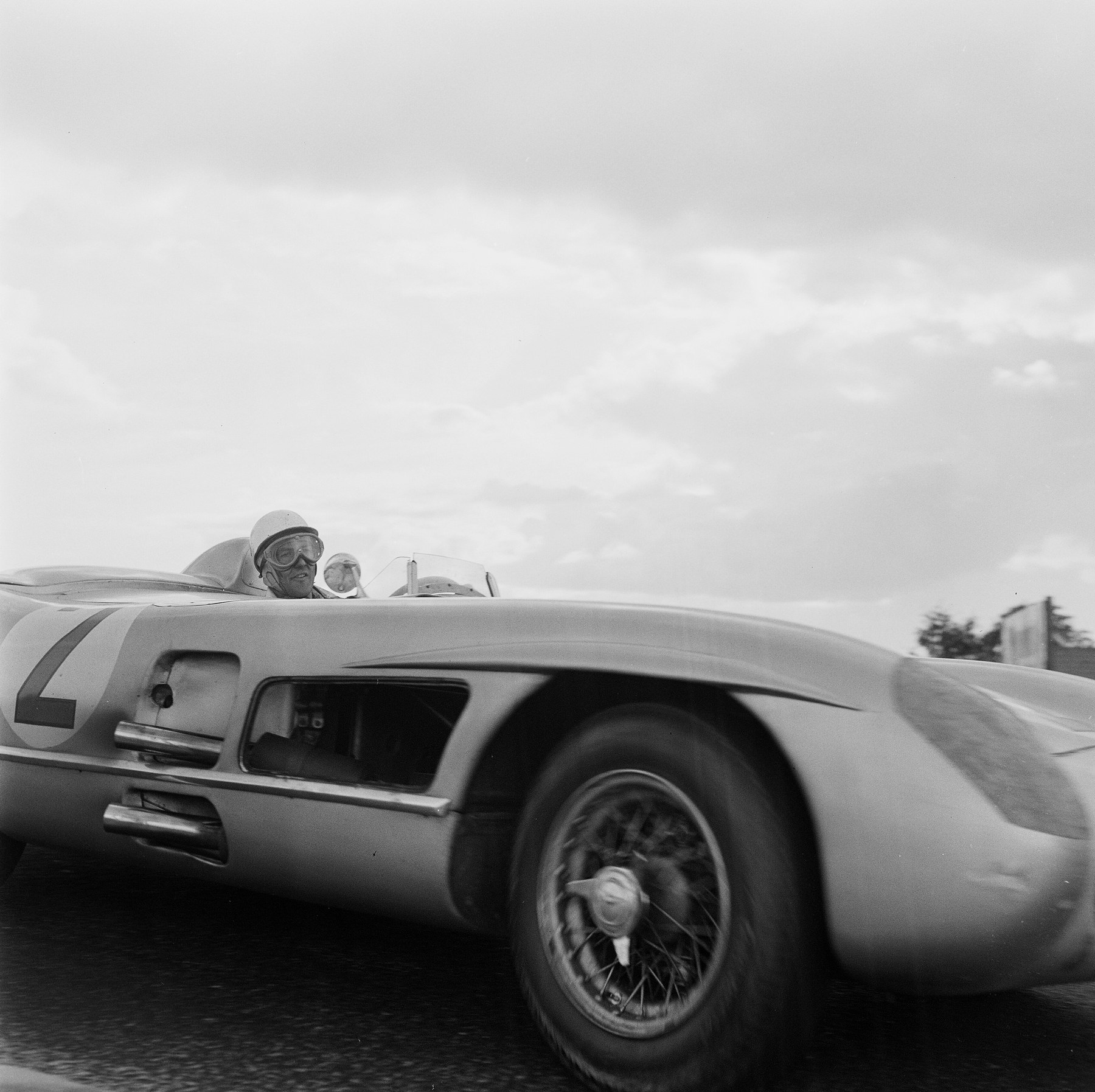
His number in the Tourist Trophy was usually 7. It was on the XK120 at Dundrod in 1950 and on the C-type in 1951, on the DBR1 in 1958 and on Walker’s Ferrari in 1960 and 1961: five of his seven wins. It was on the GTO entered for him at Goodwood on 18 August 1962, too, and he was not there to drive it. On 23 April, at the same circuit, he had crashed, and the chapter Goodwood, 23 April 1962 tells that day.
Notes
The 1953 Tourist Trophy: 3rd on distance in RacingSportsCars’ results, 4th in a Northern Whig headline of 7 September 1953. The 1954 race: 14th in RacingSportsCars, 18th in Motor Sport’s report. ↑
Later accounts speak of a car with no brakes. The report of April 1954 names a slipping clutch, and says it was the Maseratis that lost their brakes. ↑
RacingSportsCars lists his name, marked with an asterisk, on the winning Jaguar of 1953 and the winning Aston Martin of 1959: he was a nominated reserve for those cars and never drove them. Two laps is the lead given in 1955 by Motor Sport’s editorial of July that year; a later account says four. One later account also gives his last Le Mans as 1960; he did not race there that year. ↑
Motor Sport’s report of 1958 says the engine broke after 2 hours 10 minutes; its later retrospective names a broken connecting rod in the third hour. ↑
Seven killed and 40 injured, by Richard Williams’s account in Motor Sport in 2014; other accounts give six or eight. ↑
The chassis histories give one car for 1960 and another for 1961. Motor Sport’s report of the 1961 Tourist Trophy, and its database, say he won both in the same car. Neither has been checked against a chassis register or a period photograph. ↑
Sources
Racing Sports Cars, “All Results of Stirling Moss”, and the race pages of the Tourist Trophies of 1960 and 1961. racingsportscars.com
Motor Sport, 1950–1955: “Jaguars’ sweeping victory in the Dundrod T.T.” (October 1950); “Stirling Moss wins the T.T. for Jaguar at record speed” (October 1951); “Mercedes-Benz win Les Vingt-Quatre Heures du Mans” (July 1952); “Les 24 Heures du Mans 1953” (July 1953); “Surprise victory in Sebring 12-hour race” (April 1954); “Les Vingt-Quatre Heures du Mans 1954” (July 1954); “Les Vingt-Quatre Heures du Mans 1955” and “Matters of Moment” (July 1955); “Ulster Tourist Trophy” (October 1955); “The Thirty-Ninth Targa Florio” (November 1955). motorsportmagazine.com
Motor Sport, 1956–1961: “The Argentine season” (March 1956); “The 1,000-kilometre race at Nürburgring” (July 1956); “Les Vingt-Quatre Heures du Mans 1956” (September 1956); “The Argentine racing season” (March 1957); “Les Vingt-Quatre Heures du Mans” (August 1957); D.S.J., “Continental notes” (December 1957); “Les Vingt-Quatre Heures du Mans” (August 1958); “Aston Martin 1-2-3 in T.T.” (October 1958); D.S.J., “Moss the absolute master” and “Aston Martin victorious” (July 1959); “Aston Martin wins Goodwood TT and clinches 1959 sports car championship” (October 1959); D.S.J., “The ADAC 1,000-kilometre race, Nürburgring” (July 1960); “The TT of tyre changes” (September 1960); “Les Vingt-Quatre Heures du Mans” (July 1961). motorsportmagazine.com
Motor Sport, later: “Chapter 3: Sports cars – the sensational becomes routine”; Richard Williams, “Champion of the revolution” (March 2014); Andrew Frankel, “Stirling Moss: More than Mr Motor Racing” (June 2020); Simon Taylor, “Lunch with… Stirling Moss” (2006, reprinted June 2020); Motor Sport database, “Stirling Moss”. motorsportmagazine.com
Andrew Frankel, “Thank Frankel it’s Friday: Why didn’t Moss win Le Mans?”, Goodwood Road & Racing, June 2019. goodwood.com
ACO, “British drivers at the 24 Hours of Le Mans (2/3): Stirling Moss, a remarkable career”, 2019. 24h-lemans.com
Gian Luca Pellegrini, “Stirling Moss: «Se non apprezzi più l’azzardo e il pericolo a ogni curva è l’ora di smettere»”, Quattroruote (interview of 2011). quattroruote.it
Scuderia Corsa, “1961 Ferrari 250 GT SWB S/N 2735”, and Sports Car Digest, “Ferrari 250 GT SWB Competition”: chassis histories. scuderiacorsa.com; sportscardigest.com